

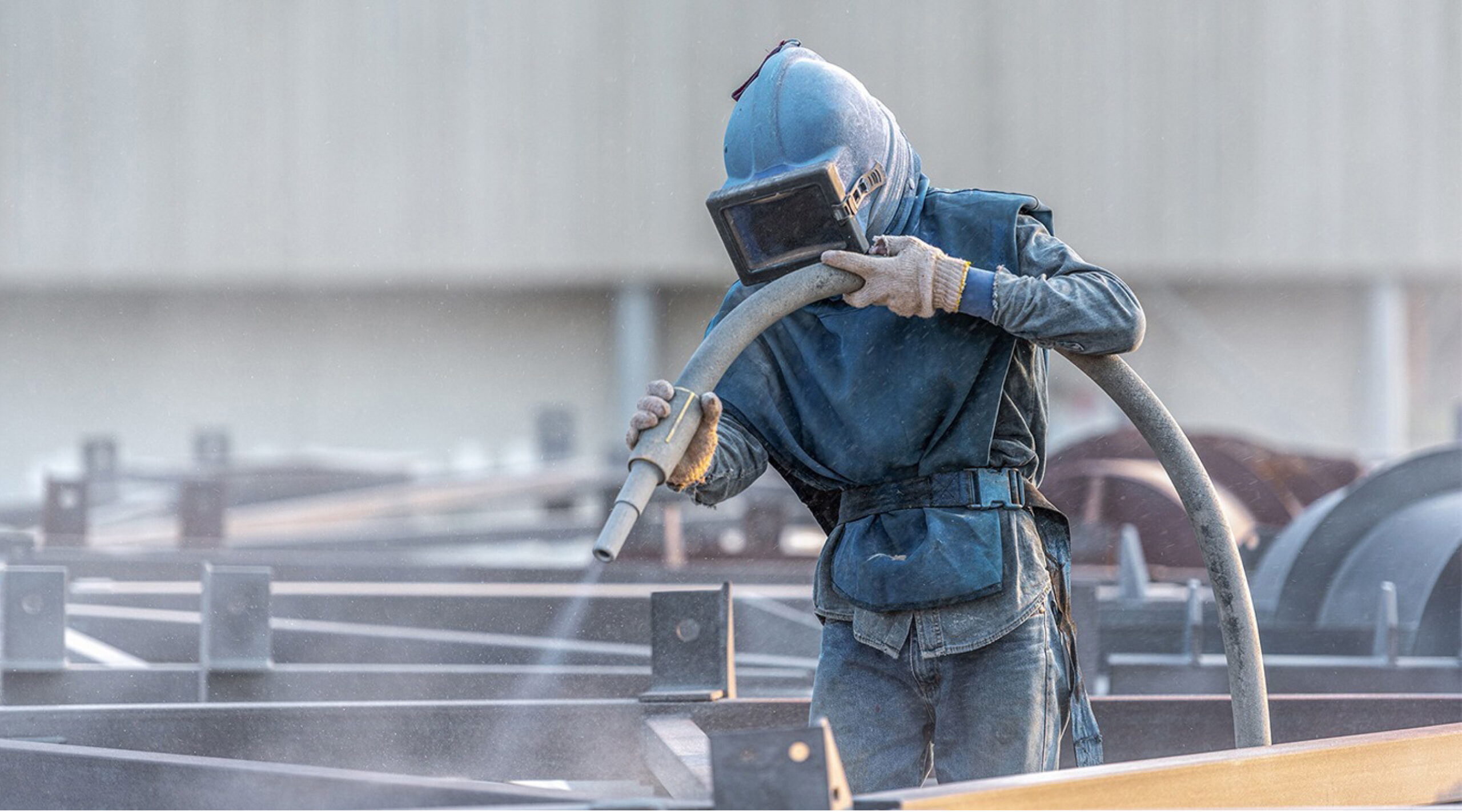
If you’re thinking about having a surface cleaned, stripped, or restored, you’ll probably hear terms like “grit,” “media,” or “abrasive.” At Atlanta Blasting Professionals, we keep it simple:
“Grit” is the hardness and size of the particles we use to clean your surface. Choosing the right grit is like choosing the right tool:
- Too harsh, and you can damage the surface.
- Too gentle, and the coating or rust doesn’t come off.
Our job is to match the right blasting media to your project so you get a clean, restored surface without unnecessary damage or cost.
Expert Note: While many call this “Grit Blasting,” it’s actually the art of Abrasive Blasting. “Grit” is just the specific tool we choose for the job. Whether we use angular steel grit for industrial rust or soft walnut shells for residential wood, the process is built on precision media selection.
The Science Behind It (Explained Simply)
In the blasting world, we often refer to the Mohs Scale, which measures how hard a material is on a range from 1 to 10:
- 1 = very soft material.
- 10 = extremely hard material.
Soft Media: Gentle Cleaning for Sensitive Surfaces
Soft blasting media is gentle and ideal for restoring sensitive surfaces like wood or fiberglass.
- Sodium Bicarbonate (baking soda).
- Crushed walnut shell.
- Corn cob.
Medium Grit: Versatile, Effective, and Eco-Friendly
Most projects fall into the medium grit category, offering a balance of cleaning power, surface protection, and cost-effectiveness. Our most-used media is recycled crushed glass due to its performance and eco-friendly nature.
Hard Media: When You Need Maximum Cutting Power
For the toughest coatings such as heavy rust, thick paint, or mill scale we use harder abrasives such as:
- Copper slag
- Garnet
Examples of Media We Use
- Sodium Bicarbonate (Soft – Mohs 2.5): Wood, fiberglass, delicate surfaces.
- Fine Crushed Glass (Medium – Mohs 5.5): Auto parts, carbon fiber.
- Medium/Coarse Crushed Glass (Mohs 6.5): Metal, brick, concrete.
- Copper Slag (Coarse – Mohs 7.0): Mill scale removal.
- Garnet (Coarse – Mohs 7.5): Mill scale and coating removal.
How Grit Blasting Works
Here’s the basic process of how grit blasting works:
- A blasting machine pressurizes air or water.
- Abrasive grit is mixed with the pressurized stream.
- The mixture is blasted through a nozzle toward the surface.
- The impact removes layers, contaminants, or unwanted materials.
It’s a fast, controlled, and highly efficient cleaning method used for both small and large-scale projects.
The Grit Blasting Process: Step-by-Step
- Inspection & Assessment: Evaluate the condition of metal, concrete, or wood.
- Surface Masking: Protect surrounding areas not meant to be blasted.
- Selection of Media: Choose grit type based on the surface (steel grit, garnet, glass bead, aluminum oxide).
- Blasting: Apply abrasive at controlled pressure and angle.
- Cleanup: Remove dust and debris.
- Coating/Finishing: Apply primer, paint, or sealant immediately to prevent flash rust.
Types of Grit Blasting
Different blasting methods exist depending on material, finish, and project requirements:
- Dry Grit Blasting: Most common for heavy rust and paint removal.
- Wet Grit Blasting: Uses water to reduce dust; safer in closed spaces.
- Vacuum Blasting: Collects abrasive and dust instantly; clean and eco-friendly.
- Automated Blasting Systems: Used in industries for large batches of metal parts.
Where Grit Blasting is Used
Grit blasting works on many surfaces, such as:
- Metal (rust removal & coating prep).
- Concrete (floor prep, coating removal).
- Wood (restoration, refinishing).
- Tiles & masonry (cleaning, texturing).
It is commonly used in construction, manufacturing, marine, automotive, and restoration industries.
Benefits of Grit Blasting
- Deep cleaning of surfaces.
- Better coating adhesion.
- Faster than manual scraping or grinding.
- Removes hard contaminants easily.
- Provides a uniform surface finish.
- Works on multiple materials.
Grit Blasting vs Sandblasting
Many people confuse these two, but they’re different:
- Grit blasting uses angular abrasives for deeper cutting.
- Sandblasting typically uses sand, but is now less popular due to silica dust risks.
- Grit blasting is safer, more effective, and more versatile.
Grit Blasting vs Shot Blasting
- Shot blasting uses round metallic balls (shots) and is mainly used for heavy industrial floors.
- Grit blasting uses sharper particles for precision cleaning.
Bring Your Surfaces Back to Life with Professional Grit Blasting
If you’re dealing with rust, old paint, corrosion, or surfaces that just won’t look clean no matter what you try, grit blasting is the fastest and most effective solution. For safe, high-quality, and professional surface preparation, Atlanta Blasting Professionals is here to help.
Contact Atlanta Blasting today for expert grit blasting services in Atlanta.
Restore your metal, concrete, and wood surfaces with precision, done right the first time.
FAQ's
Grit blasting is a surface cleaning and preparation method where abrasive particles are propelled at high speed to remove rust, paint, scale, and contaminants. The impact creates a clean, roughened surface ideal for coating or painting.
Works on metal, concrete, tile, and wood.
- Grit blasting uses angular abrasive particles (such as garnet and steel grit) for deeper cleaning.
- Sandblasting uses sand, but is less common today due to safety concerns.
- Shot blasting uses round steel shots and is more suitable for heavy-duty industrial surfaces.
- Metal (rust removal & coating preparation)
- Concrete (cleaning & profile creation)
- Tile (adhesion preparation)
- Wood (paint removal without chemical damage)
- Full PPE (respirators, suits, gloves, helmets)
- Dust containment systems
- Low-dust abrasive media
- Controlled pressure settings to protect surfaces and workers
Cost depends on surface size, material, and level of buildup. Most small jobs take a few hours; larger surfaces may take a full day.
For exact pricing, request a quote from your local grit blasting provider.
- A dust-free, chemical-free cleaning method
- Better coating adhesion
- More uniform surface preparation
- Faster results compared to acid cleaning or manual grinding