

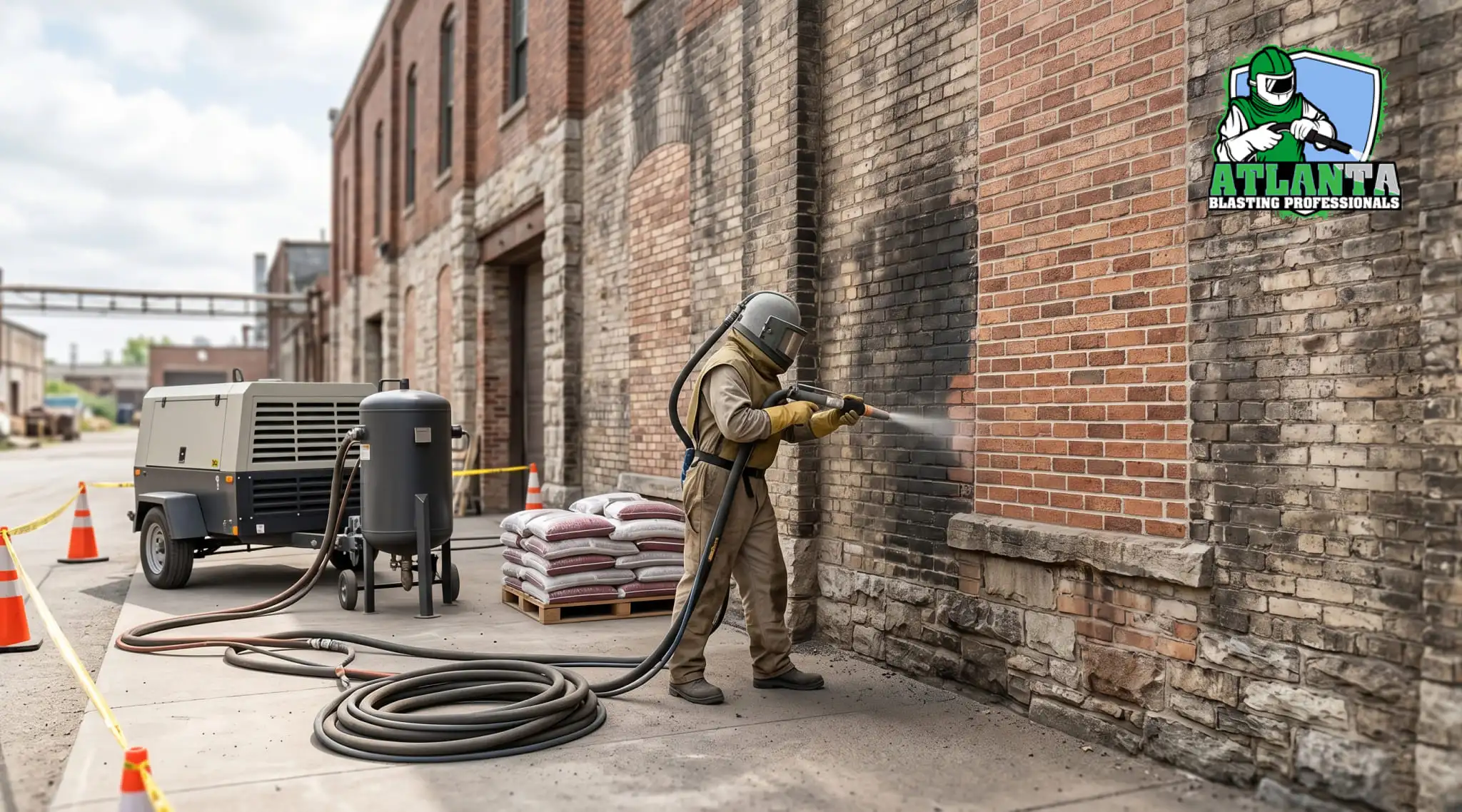
The real cost behind professional mobile sandblasting services, and why the price reflects something far more valuable than a cleaning job.
When a property owner first hears that mobile sandblasting costs $300 to $500 per hour or several thousand dollars for a project, the instinctive reaction is sticker shock. That reaction is understandable. But it’s also a reflection of how little is understood about what professional mobile sandblasting service cost actually involves.
This is not pressure washing. It is not a garden hose with grit attached to it. Mobile sandblasting or mobile abrasive blasting is a sophisticated industrial restoration process that requires specialized engineering, dangerous pressurized systems, consumable materials burning through hundreds of pounds per hour, and a level of operator skill that takes years to develop safely.
Once you understand what goes into a single mobile sandblasting job, the question shifts entirely. It stops being “Why is this so expensive?” and becomes “How do they do it for this price?”
Why is Mobile Sandblasting Expensive?
The biggest reason mobile abrasive blasting costs more than many people expect is because contractors bring an entire industrial restoration setup directly to your property or job site.
Unlike shop blasting operations, mobile crews transport heavy equipment, blasting media, fuel, containment systems, and safety gear to every project location.
Professional commercial sandblasting companies operating expenses are substantial including:
- Industrial blasting equipment and technology
- Media appropriate for the surface being restored
- Specialized PPE safety gear
- Fuel and transportation costs
- Environmental compliance
- Insurance premiums
- Skilled technical labor
When you hire a professional media blasting contractor, you are paying for expertise, protection, efficiency, and the ability to restore valuable surfaces correctly.
1. The Equipment Alone Is Worth More Than Most People’s Homes
Let’s start with the hardware.
A professional, towable mobile sandblasting rig is not a piece of equipment you rent from a hardware store. A complete, turnkey commercial setup including industrial air compressors, heavy-duty blast pots, moisture management dryers, industrial hoses, nozzles, and the truck and trailer required to haul it. It represents an upfront capital investment of $55,000 to $150,000 or more.
The compressors required to generate the amount of air pressure for properly sandblasting surfaces are not consumer-grade machines. They are industrial workhorses that demand constant maintenance, periodic rebuilding, and eventual replacement. The median price of a 185 CFM compressor is roughly $30,000 uninstalled.
Every hour a contractor runs this equipment on your project, they are drawing down on that capital investment. The equipment does not last forever, and replacing it is not cheap. When you understand the commercial sandblasting equipment behind the quote, the rate starts to look very reasonable.
2. Blasting Media Is Consumed at a Staggering Rate
Here is something most people never consider: the abrasive material itself is a major, recurring cost, and it disappears fast. A professional mobile abrasive blasting operation can burn through hundreds of pounds of media per hour, depending on the surface, the profile required, and the media type selected.
Unlike a shop cabinet system that recirculates media in a controlled indoor environment, a mobile operation cannot recover and recycle spent material on-site. Once it’s used, it’s gone. Every bag is a direct cost that has to be factored into the cost of the restoration project.
The choice of media also dramatically affects abrasive blasting cost. Common options include:
- Crushed glass or coal slag: affordable and aggressive, suited for heavy rust and industrial steel ~ $0.33 to $ 0.66 per pound and this is the least expensive blasting media, the other options below run at pricing per pound at a much higher price point
- Garnet: mid-range cost, excellent for fine profiling on metal
- Aluminum oxide: high-performance, high cost, used for precision work
- Walnut shells or baking soda: gentle and expensive, required for delicate surfaces like historic masonry or classic car panels
For jobs requiring specialty media whether to protect fragile stone, antique brick, or thin-gauge automotive metal, media blasting prices reflect those material choices directly. There is no way around it.
3. This is a Skilled Trade, And Skill is Expensive for Good Reason
People routinely underestimate the expertise required to perform professional sandblasting safely and correctly. This is one of the most persistent misunderstandings in the industry.
An experienced blasting technician must understand surface hardness, the correct PSI for each substrate, blast angle, moisture control, heat buildup, and how to achieve the precise surface profile required before coatings are applied. Get any of these variables wrong and the consequences are immediate and expensive:
- Warp or ripple thin automotive metal panels beyond repair
- Etch or frost glass that cannot be replaced without major cost
- Destroy underlying substrates
- Permanently damage wood siding, decking, or structural timbers
Before a single trigger is pulled, a skilled technician may spend hours on preparation alone: masking off sensitive surfaces, building containment zones, laying heavy tarps, erecting dust suppression systems, and protecting adjacent structures and landscaping. The physical act of blasting itself is demanding, exhausting manual labor performed in full respirator helmets and climate-controlled protective suits in punishing conditions.
4. Mobile Logistics: You Are Paying for an Industrial Shop to Come to You
A fixed-location blasting shop has one significant advantage: it doesn’t move. All overhead containment, power, compressed air, media recovery, is permanently engineered into the facility and amortized across every job that walks through the door.
A mobile sandblasting operation eliminates that advantage entirely. Every project requires the contractor to load, transport, set up, operate, contain, clean up, and transport everything back , at the client’s location, in whatever conditions exist there. The hidden costs of mobile logistics include:
- Heavy-duty trucks and equipment trailers with significant per-mile operating costs
- Large diesel air compressors consuming gallons of fuel every hour of operation
- Portal-to-portal billing, the clock starts when they leave the shop, not when blasting begins
- On-site containment systems that must be built from scratch for every project
- Environmental compliance costs, particularly for jobs involving lead paint or hazardous coatings
- Travel time between projects that cannot be billed but must be absorbed
For those searching for mobile sandblasting near me or an onsite sandblasting contractor in Atlanta, it’s worth understanding that this convenience brings an industrial facility directly to your property. It itself is a premium service. It is the only practical solution for structures that cannot be moved: commercial buildings, swimming pools, heavy equipment, vehicle frames, masonry walls, and industrial machinery.
5. Insurance Premiums Are Extraordinarily High Because the Risk Is Real
Professional sandblasting contractors operate around some of the most high-value assets imaginable: classic and collector vehicles, commercial buildings, industrial machinery worth millions of dollars, marine vessels, historic structures, and residential properties with all the liability that entails.
A pressurized stream of abrasive media traveling at industrial velocity can slice through the wrong surface, shatter glass, or cause structural damage in a fraction of a second if the operator misjudges angle, pressure, or distance. Injuries to operators and bystanders can be catastrophic. The equipment itself operates under extreme pressure and represents significant safety risk if improperly maintained or operated.
Because of these realities, professional industrial sandblasting contractors carry multiple layers of insurance coverage:
- General liability insurance: protection against property damage and third-party injury claims
- Commercial auto insurance: covering vehicles and trailers hauling heavy equipment
- Workers’ compensation: mandatory for protecting operators performing dangerous manual labor
- Environmental liability coverage: particularly important for projects involving hazardous materials
- Equipment insurance: covering the replacement of machinery that can cost six figures
These premiums are not incidental. They are a substantial line item in every contractor’s operating budget. Plus, they are non-negotiable for any legitimate, professional operation. When you hire a media blasting contractor who carries proper coverage, you are protected. When you hire one who doesn’t, you are the coverage.
6. Restoration vs. Replacement: The Compelling Math
Here is the argument that puts mobile sandblasting service cost in its proper context: in almost every application, professional restoration through abrasive blasting is dramatically less expensive than replacement.
Consider a commercial property with aging brick facades showing decades of paint buildup, industrial grime, and surface deterioration. The cost of professional commercial sandblasting to strip and restore that brick to its original condition is a fraction of what it would cost to demolish and rebuild, or even to re-clad the structure in new materials. The structural integrity of the underlying brick is preserved. The character and aesthetic of the original material is recovered. The building’s value is protected.
The same logic applies across every category of application:
- Industrial machinery: Professional blasting removes rust, failed coatings, and contamination, extending the operational life of equipment that costs hundreds of thousands of dollars to replace
- Marine vessels: Hull restoration through blasting removes antifouling coatings and corrosion at a fraction of the cost of replating or hull replacement
- Automotive restoration: Sandblasting a classic car’s frame and body panels correctly, with the right soft media, preserves the original metal that cannot be reproduced and eliminates the risk of hidden corrosion beneath fresh paint
- Residential masonry: Restoring stone, brick, and concrete through blasting preserves the structural and visual integrity of surfaces that took skilled tradespeople to create and cannot be replicated at any reasonable cost
What Does Mobile Sandblasting Cost? Industry Price Ranges
The cost of sandblasting varies significantly based on project type, surface condition, material sensitivity, containment requirements, and accessibility. The following ranges represent professional-grade industrial sandblasting pricing from qualified contractors:
| Project Type | Typical Price Range | Key Cost Factors |
|---|---|---|
| Automotive / Vehicles | $1,500 – $3,000+ | Vehicle size, intricate panel designs, delicate metals requiring soft media, and flash-rust primer application. |
| Boats / Marine Hulls | $35 – $120+ per linear foot | Strict environmental containment, marine-grade antifouling paint removal, and hull accessibility. |
| Heavy Equipment | $4,000 – $50,000+ | Thick industrial coatings, extensive rust scale, and massive surface areas. |
| Residential / Masonry | $2.75 – $30.00 per sq. ft. | Media choices to prevent surface damage (e.g., wood vs. wrought iron) and proximity to neighbors. |
These figures reflect the full cost of a professional job, proper surface preparation, correct media selection, containment, cleanup, and skilled execution. Lower quotes from unqualified contractors rarely include these elements and often result in damage that costs far more to remediate than the savings achieved.
Choosing the Right Mobile Sandblasting Contractor
When evaluating mobile sandblasting services, whether you are searching for mobile sandblasting near me or specifically seeking industrial blasting services in Atlanta, price should be one factor among several, not the deciding one.
A professional contractor should be able to clearly answer:
- What media will you use, and why is it right for this surface?
- What containment system will you deploy, and how will spent media be handled?
- What insurance coverage do you carry, and can you provide certificates?
- How many projects like this have you completed, and can you provide references?
- What surface profile will you achieve, and how will you verify it before coating?
The answers to these questions separate professional industrial sandblasting contractors from operators who own a used blast pot and a truck. The difference in outcomes is not marginal, it is the difference between a surface restored to a better-than-original condition and one that requires expensive remediation.
Final Thoughts
Mobile sandblasting is not expensive because contractors are overcharging. It is priced at a premium because it involves significant capital equipment, continuous consumable costs, dangerous and skilled manual labor, major insurance obligations, and the logistical complexity of bringing an industrial operation directly to your site.
The perception that mobile sandblasting is expensive dissolves the moment you understand what you are actually buying. You are not paying for someone to blast grit at your wall. You are paying for expertise, engineered equipment, liability protection, years of hard-won skill, and a result that will outlast every cheaper alternative.
Ready to restore rather than replace? Contact Atlanta Blasting Professionals for a professional assessment of your project.
FAQ's
Most professional contractors charge $350–$500 per hour or several thousand dollars per project. Final pricing depends on surface type, media selection, project size, and containment needs.
They are completely different services. Sandblasting uses industrial-grade pressurized abrasive media to strip rust, paint, and coatings from surfaces water cannot touch, backed by $55,000–$150,000+ in equipment and years of specialized operator training.
Verify insurance coverage, ask what media they plan to use and why, and request references. A qualified contractor will ask detailed questions about your surface before quoting, not give you a flat rate over the phone.
Dustless blasting mixes water with abrasive media to suppress dust, reduce containment needs, and prevent flash rusting on metal. It costs slightly more but is often the better choice for residential, automotive, and urban projects.
Absolutely. Brick restoration, wrought iron, wood stripping, pool surfaces, and driveways are all common residential applications. The key is media selection, residential surfaces need gentler abrasives than industrial steel to avoid damage.
Case Study: Why Restoring Beats Replacing (A $30K Lesson for GCs)
As a general contractor, saving your client’s budget and timeline is the fastest way to become their go-to partner.
When a commercial building found severe rust on the structural steel supports under its main entrance pedestrian bridge, a total teardown seemed like the only option.
But instead of ripping it out, they ran the math on a restoration. Here is the breakdown that saved the day.
The Rebuild vs. Restore Breakdown
| Impact Metric | Option 1: Demolition & Rebuild | Option 2: Sandblast & Recoat |
|---|---|---|
| Financial Cost | $35,000 – $45,000 | $15,000 |
| Project Timeline | Several weeks | 3 days |
| Site Disruption | High (Blocked main entrance) | Minimal (Traffic keeps moving) |
3 Reasons This Was a Win for the GC and the Client
1. Massive Cost Savings
Choosing restoration over a total rebuild saved the client between $20,000 and $30,000. Offering this kind of value engineering builds massive trust and wins repeat business.
2. Solving the Root Cause
The $15,000 restoration budget did not just fix the surface look. It also covered repairing the active water leak causing the corrosion, stopping future damage before it could start.
3. Fast Turnaround, Zero Headaches
A multi-week construction project at a main entrance hurts the tenant experience. Sandblasting and recoating took just three days, keeping daily foot traffic moving with zero complaints.
The Bottom Line
Don’t assume old metal belongs in the landfill. Before you bid out a costly replacement project, run the math on professional industrial restoration to protect your client’s wallet and your project schedule.